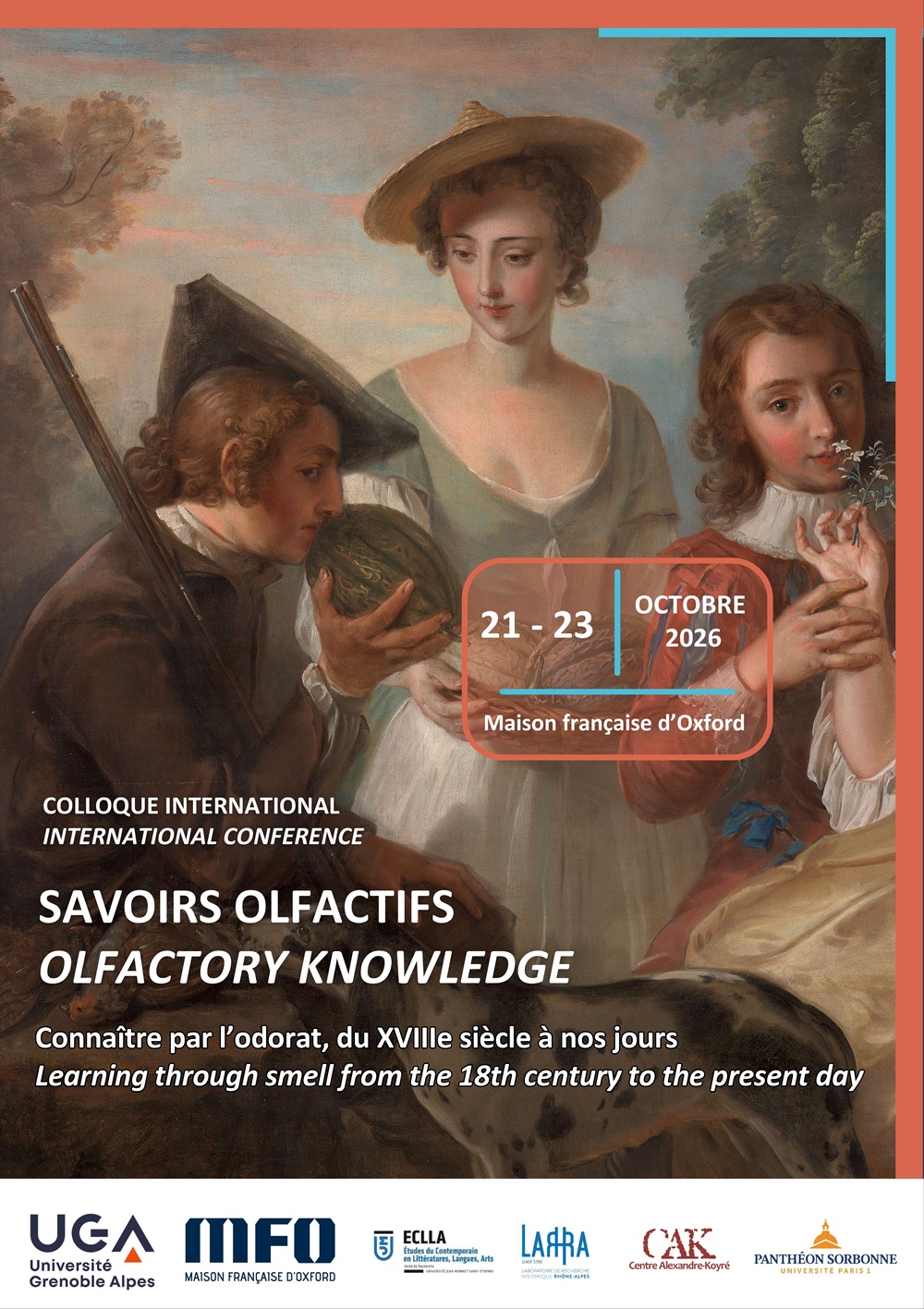
International Conference
‘Olfactory knowledge: Learning through smell from the 18th century to the present day’
21, 22, & 23 October 2026
Maison Française d'Oxford
Convened by Rémi Digonnet (Université Jean Monnet Saint-Étienne), Judith Rainhorn (Université Paris 1 Panthéon-Sorbonne), Marie Thébaud-Sorger (CNRS/Centre Alexandre Koyré), and Érika Wicky (Université Grenoble-Alpes)
According to Condillac, smell is “of all the senses, the one that seems to contribute least to the knowledge of the human mind”. This widely shared conception since the 18th century will be challenged at this interdisciplinary conference.
Beyond the necessary knowledge for survival (such as recognising the quality of air and food) and social stereotypes conveyed by olfaction, olfactory knowledge is an integral part of many scholarly, medical, artisanal, and domestic practices. In the field of crafts, olfaction is most often tacit knowledge, and smell is often used to indicate adulterated materials or advanced chemical transformation processes. Meanwhile, the emergence of synthetic raw materials, which encouraged creativity in perfumery, paved the way for the formulation of aesthetic judgments based on smell. Since the 20th century, perfumers and oenologists have reinforced the idea of olfactory expertise.
The various uses of smell invite us to reconsider the relationships between tacit and prescriptive knowledge and their multiple combinations. By focusing on the uses of olfactory knowledge in multiple contexts, this conference should allow to reconsider the status of this sense, from the “olfactory revolution” identified in the 18th century up to the most recent advances in neurosciences.
21 octobre - 17h
Mot de bienvenue / Welcome address
Stéphane Van Damme, directeur de la MFO
Atelier olfactif / Olfactory Workshop:
Giulio Giorgi, paysagiste / landscape designer
Knowing Plants by Scent: What Smell Reveals about Botany and Ecology
22 octobre :
9h – 9h30: Introduction - Salon
Objectiver les savoirs olfactifs / Objectifying Olfactory Knowledge - Salon - Chair : Judith Rainhorn, Université Paris 1 Panthéon-Sorbonne / CHS
9h30 – 10h : Christelle Lacassain, Sorbonne Université / CeLiSo
The smell of words? From smell constructions to olfactory knowledge
10h-10h30 : Moustafa Bensafi, CNRS / Centre de recherche en neurosciences de Lyon
From subjectivity to instrumentation: contemporary transformations in olfactory knowledge in the context of anosmia
10h30 – 11h : Pause / Break
11h – 11h30 : Raghad Al Dirani, Université Lyon 3 / Centre d’études linguistiques
The semantic evolution of the senses of the verb stink
11h30 – 12h : Bodo Mrozek, Berlin Center for Cold War / Leibniz Institute for Contemporary History
The Measurement of Smell. Olfactory Events and their Aftermath in the 20th Century
12h00 – 13h30 : Pause déjeuner / Lunch Break
Savoirs médicaux et vernaculaires / Medical and Vernacular Knowledge
- Auditorium - Chair : Marie Thébaud-Sorger, CNRS / CAK
13h30 – 14h00: Tassanee Alleau, Université de Tours / CESR
Scents of Roots: Remedies, Olfactory Expertise, and Women’s Knowledge in 18th-Century English Cooking
14h00 – 14h30 : Clément Fabre, Université Paris Est Créteil / CRHEC
Fœtor ex ore: The Medicalisation of Olfactory Knowledge about Bad Breath in Nineteenth-Century France
14h30-15h00 : Clara Granieri, Université Paris Saclay-Versailles / CHCSC
Smell and judge : how the sense of smell enabled French veterinarians to assess livestock farming practices in the 19th century
15h00 – 15h30 : Charlotte Gaudry, Université Grenoble Alpes / LARHRA
Entre persistance des savoirs olfactifs anciens et émergence d’une approche plus physiologique des sens, analyse des travaux de Luigi Martorelli (1760-1831) autour des odeurs.
15h30 – 16h00 : Pause / Break
Atmosphères olfactives / Olfactory Atmospheres – Auditorium - Chair : Martine Drozdz, CNRS / MFO
16h00 – 16h30 : Lou Sompeirac, ENSA de Montpellier / LIFAM
Micros-savoirs-olfactifs chez un public non-expert à Pékin et Mumbai : d’une transmission domestique à une attention écologique sensorielle
16h30 - 17h00 : Manon Raffard, The University of Manchester
“Best Known by the Smell.” Olfactory Perception and Environmental Knowledge in the Work of Robert Angus Smith (1817-1884)
17h00 – 17h30 : Suzel Balez, ENSA Grenoble / Cresson and Jieling Xiao, Birmingham City University
Olfactory Empirical Knowledge Drawn From Smellwalks in Three Countries
Dîner / Dinner – Cherwell Boathouse
23 octobre :
Histoire en parfums 1 / History Through Perfume 1 – Salon – Chair : Rémi Digonnet, Université de Saint-Étienne / ECLLA
9h00 – 9h30 : Zara Kesterton, University of Cambridge
Scented illusions: artificial flowers, knowledge, and perfume in eighteenth- and nineteenth-century France
9h30 - 10h00 : Léonie Maillard, Université Grenoble Alpes / LARHRA
Rethinking Edmond Roudnitska’s Theory on Olfactory expertise : Intuition, Authority, and the Industrial construction of Sensory Archetypes
10h00 – 10h30 : Virginás Peter, Babes-Bolyai University
The Transitivity of Masculinity: Olfactory Practices and Selfhood in Central and Eastern Europe
10h30 – 11h00 : Pause / Break
Histoire en parfums 2 / History Through Perfume 2 – Salon – Chair : Isabelle Chazot, LARHRA
11h00 – 11h45 : Youness Amharar, ISIPCA and Marie Urban Le Fèbvre, Independant Perfumer
From “Animal” Musk to “Clean” Musk, from Ambergris to “Ambery” Notes: Semantic Drift and the Emergence of an Olfactory and Linguistic Dichotomy in Modern Perfumery (19th–21st Centuries)
The Nose of the Chemist, Georges Darzens and his Legacy in Perfumery
12h30 – 14h00 : Pause déjeuner / Lunch Break
Savoirs olfactifs en représentation / Olfactory Knowledge in Representation – Salon – Chair : Érika Wicky, Université Grenoble Alpes / LARHRA
14h00 – 14h30 : Julia Ostwald, Kunstuniversität Linz
Olfactory Forces in 19th-century Ballet and Psychophysiology
14h30 – 15h00 : Sandra Barré, Paris 1 Panthéon-Sorbonne / ACTE
Breathable signs: olfactory symbols and embodied knowledge in contemporary art
15h00 – 15h30 : Leah R. Clark, University of Oxford / Kellogg College
Collecting histories, the senses, and museum exhibitions